New Doors · Oshawa
Commercial Sectional Door Repair
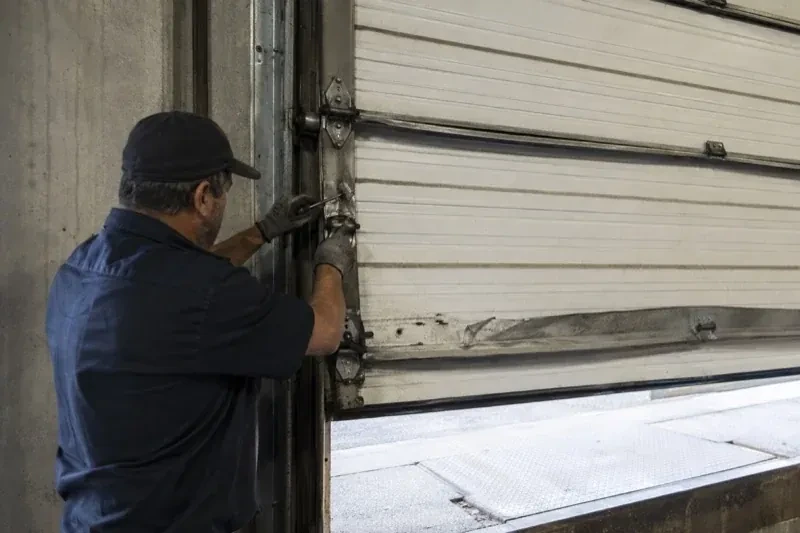
The door reaches the floor, then reverses before staying closed. The threshold is clear, but a sensing edge is distorted and one photoelectric sensor has moved out of line with its partner.
Commercial Sectional Door Repair
In plain words
High-lift and vertical-lift doors need repair methods suited to their track geometry. Cable tension, drum selection, shaft condition, track support and the transition from vertical travel all affect whether the sections remain controlled. The technician records the configuration before disassembly, supports the door at a stable position and matches replacement components to the door weight and lift arrangement. After reassembly, level travel and cable seating are observed at several positions rather than judged only with the door closed.
How the visit goesA high-lift door begins smoothly, then a cable loses tension as the top sections change direction. The loose cable no longer follows its drum grooves evenly, leaving the door unreliable at the top of travel.
Oshawa
How the visit goes
Reviewing high-lift geometry
High-lift and vertical-lift systems are identified before components are ordered. The technician records door dimensions, track rise, drum arrangement, shaft location, cable path, spring information and operator connection. Back hangs, sway braces, track splices and end stops are examined because movement overhead can appear as cable trouble below. Cable tension is observed at key transitions, especially near the open position. The resulting measurements guide part selection and show whether the fault came from wear, lost support, changed adjustment or a mismatch within the lift arrangement.
Replacing an impact-damaged section
The affected section is supported while hinges, rollers and connected hardware are transferred or renewed. The replacement is matched for thickness, construction, profile and required reinforcement so it fits the neighbouring sections and carries the same hardware pattern. Bent end stiles or struts are addressed as part of the section assembly. Rollers are returned to the correct hinge positions, section joints are aligned and fasteners are set securely. Track clearance is then checked through the curve so the new panel travels without rubbing or opening gaps.
Quieter hardware with a care routine
New rollers, hinges or bearings reduce play at the points that previously knocked or vibrated. Ongoing care means using the lubricant and interval stated for the installed door, applying it to moving pivots and bearings rather than coating the track. Tracks stay clean so rollers can travel on a firm surface without collecting grit. A simple note in the facility log describing the former sound and repaired location gives staff a reference. If a distinct noise returns at the same travel point, that observation makes follow-up assessment more focused.
Commercial Sectional Door Repair
In the van
- Track brackets and back hangs
- Bottom fixtures
- Photoelectric sensors and sensing edges
- Vertical and horizontal track
- Lift cables and drums
What affects the quote
Same fees day, night or weekend
1Corrosion and seized fasteners
Moisture and salt can affect cables, brackets, retainers, rollers and connections, broadening the repair when hardware cannot be removed or reused cleanly.
2Number of affected openings
A single bay with one defined fault differs from a facility request covering several numbered doors, separate symptoms and individual operational tests.
3Lift and track configuration
Standard, low-headroom, high-lift and vertical-lift arrangements use different track geometry, drums, cables and access methods, so the installed configuration shapes labour and parts.
Commercial Sectional Door Repair: questions
Does a torn bottom seal always mean a seal-only repair?
Not always. The rubber may simply be worn, but a bent retainer, uneven floor, crooked door or impact-damaged bottom section can produce the same gap. The technician checks how the door lands before replacing material. Correcting level or retainer shape first allows the new seal to contact evenly without being stretched to compensate for another fault.
What causes a commercial sectional door to become noisy?
Common sources include roller-bearing wear, loose hinges, dry pivots, a rubbing panel, track movement, shaft-bearing wear and operator-chain vibration. The point in the cycle where the sound occurs helps isolate it. A technician watches and listens during controlled travel, looks for play or contact marks, and services the component creating the repeatable noise.
Will a panel repair also address the operator?
The operator is reviewed when panel damage changes door movement, balance or closed position. After the mechanical repair, the drive connection, limits and protective devices can be checked against the restored travel. This is especially useful after impact, because a bent section may have made the operator stop early or apply force against resistance before the damaged panel was replaced.
Installation & Upgrades
- Insulated Steel Garage Door InstallationYou want windows for natural light without turning the garage into a cold glass wall.
- Wind-Rated Garage Door ReplacementStrong gusts make the centre of your wide garage door bow inward and the rollers chatter in their…
- Carriage-House Garage Door InstallationThe garage feels dim whenever the overhead door is closed.
Commercial Sectional Door Repair near you
Households in Oshawa mostly need three things from us over the life of a door: a tune-up now and then, a spring or cable when one lets go, and a new opener or door when the old one is finished. Every one of those, plus the smaller jobs between, is covered below.